


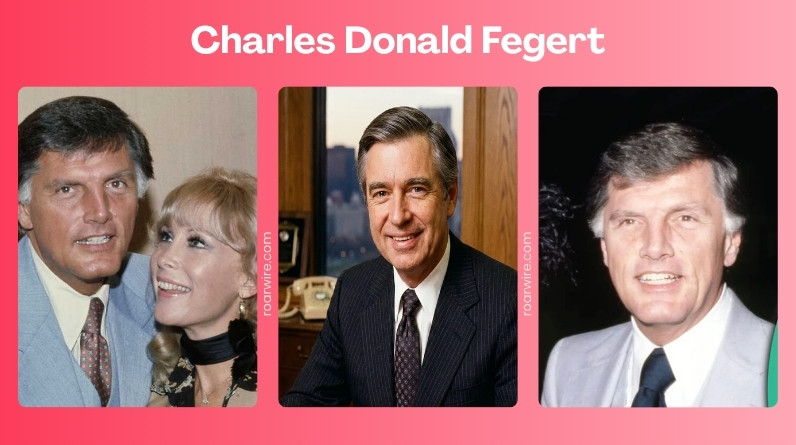
- American advertising executive known for his leadership in newspaper marketing
- Served as Vice President of Advertising and Marketing at the Chicago Sun-Times and Chicago Daily News
- Rose from salesman to executive during the peak era of print media
- Married actress Barbara Eden from 1977 to 1982, with divorce finalized in 1983
- Father of three children — daughter Lisa and sons Michael and Chip — and known for maintaining a private life
- Passed away on September 25, 2002, at the age of 71
Charles Donald Fegert was an American advertising executive who built a respected career in the newspaper industry long before his name reached public attention through his marriage to actress Barbara Eden. While many recognize him from that high-profile relationship, his real significance lies in his role in shaping advertising strategies during a pivotal era for print media.
At a time when television was rapidly transforming the media landscape, Fegert played a key role in helping newspapers remain competitive. His work at the Chicago Sun-Times and Chicago Daily News placed him among the influential figures behind the business side of journalism — an area often overlooked but essential to the survival of traditional media.
Quick Facts
| Full Name | Charles Donald Fegert |
| Date of Birth | November 8, 1930 |
| Age at Death | 71 years |
| Birthplace | Chicago, Illinois, USA |
| Nationality | American |
| Profession | Advertising Executive |
| Known For | Chicago Sun-Times & Chicago Daily News; marriage to Barbara Eden |
| Education | Loyola University Chicago (graduated 1955) |
| Years Active | 1950s–1990s (approx.) |
| Spouse | Barbara Eden (m. 1977; div. 1983) |
| Children | Three (Lisa, Michael, Chip) |
| Net Worth | Estimated in the millions (unverified) |
Who Was Charles Donald Fegert?
Charles Donald Fegert was a business professional who spent decades working in advertising and marketing, primarily in Chicago’s newspaper industry. He is most widely associated with his executive role at the Chicago Sun-Times and Chicago Daily News, where he shaped advertising strategy during a period of intense competition from television.
Although his marriage to Barbara Eden brought him into the public eye, his long-term relevance comes from his work behind the scenes. He represents a generation of media executives who helped sustain print journalism through strategic advertising innovation — people whose contributions rarely made headlines but fundamentally shaped the industry.
Early Life & Background
Childhood in Chicago
Charles Donald Fegert was born on November 8, 1930, in Chicago, Illinois. He grew up on the city’s South Side, in a working-class household where his father worked as a steelworker. That upbringing — modest but grounded — left a lasting impression on how he approached both his career and his relationships.
Family Influence & Work Ethic
Life in that South Side neighborhood taught Fegert persistence, financial responsibility, and resilience. These weren’t abstract values — they were practical tools shaped by necessity, and they became central to his professional identity in the competitive advertising industry.
Early Exposure to Business Environment
Chicago’s status as a major commercial hub gave him early exposure to media, sales, and communication industries. Growing up during the postwar economic boom, when advertising was becoming a serious profession in its own right, likely sharpened his instinct for the field long before he formally entered it.
Education
South Shore High School
Fegert attended South Shore High School, where he developed the communication skills that would later prove essential in client-facing advertising roles. According to some accounts, he worked part-time jobs throughout his education to help finance his own path forward.
Loyola University Chicago
He went on to earn a business-related degree from Loyola University Chicago, graduating in 1955. The academic foundation he built there — analytical thinking, structured problem-solving — translated directly into his early work in marketing and sales.
Career Journey
Entry into Advertising (1950s)
Charles Donald Fegert began his career as an advertising salesman in the mid-1950s. The role demanded direct client interaction, sharp negotiation instincts, and a genuine understanding of what businesses needed from their marketing spend.
What set him apart early on was his consultative approach. Rather than simply selling ad space, he focused on helping clients achieve measurable results — a mindset that built lasting trust and distinguished him from the typical sales rep of the era.
Growth at Chicago Sun-Times and Chicago Daily News
He joined the Chicago Sun-Times, where he steadily advanced through the ranks. Over time, his portfolio expanded to include the Chicago Daily News — another major publication in the city’s competitive print landscape. Together, these two titles gave him broad influence over how Chicago’s newspaper industry engaged with advertisers.
During this period, he developed deep expertise in print advertising, learning how to align business goals with audience reach in ways that kept editorial and commercial interests working in the same direction.
Rise to Executive Leadership
Fegert eventually became Vice President of Advertising and Marketing — a position that put him at the center of both publications’ commercial operations. He managed major campaigns, led teams, and maintained relationships with some of the Midwest’s largest advertisers.
This role carried real weight. Advertising revenue was the financial backbone of any newspaper, and during a time when television was siphoning away ad budgets, his ability to retain and grow that revenue was critical to both papers’ survival. He held the position until 1983, when Rupert Murdoch’s acquisition of the Sun-Times brought in new management.
Career Timeline Highlights
- 1950s – Began career in advertising sales
- 1960s–1970s – Advanced through roles at Chicago Sun-Times and Chicago Daily News
- Late 1970s–1983 – Served as Vice President of Advertising and Marketing
- Post-1983 – Transitioned to consulting and private ventures
Major Achievements & Industry Impact
Contributions to Newspaper Advertising
Fegert helped reframe how newspapers sold advertising to businesses. Rather than treating ad placements as static commodities, he pushed for strategy-driven thinking — audience targeting, campaign alignment, and measurable business outcomes. For the time, that was a genuinely forward-looking approach.
Competing in the Television Era
His work was most consequential during the 1960s and 1970s, when television advertising threatened to make print irrelevant. By helping newspapers articulate their unique value to advertisers — local reach, trusted editorial context, reader engagement — he made the case for print at a moment when that case needed to be made loudly.
Leadership and Influence
Colleagues remembered him as a confident but collaborative leader. He believed in building teams rather than simply issuing directives, and his ability to maintain high-level client relationships over many years reflects just how much trust he earned in Chicago’s business community. He was also known for occasionally serving as master of ceremonies at corporate and social events, where his charm and humor made him a natural fit.
Business Ventures Beyond Advertising
Real Estate Interests
Later in his career, Fegert explored real estate development. It was a natural extension of his advertising background — understanding how to position and market properties drew on the same strategic instincts he’d honed over decades. By most accounts, these investments contributed meaningfully to his financial stability in later life.
Consulting and Mentorship
After stepping away from full-time executive roles, he shared his expertise through consulting, helping businesses sharpen their marketing strategies. He also mentored younger professionals in the advertising field — something that people who knew him described as a genuine commitment, not a formality.
Net Worth & Financial Overview
Charles Donald Fegert’s exact net worth is not publicly confirmed, but estimates suggest he accumulated wealth in the millions over the course of his career. His income came primarily from his executive roles in advertising, with additional returns from real estate investments and later consulting work.
No verified financial records are publicly available, so any figure remains speculative. That said, a decades-long career at the VP level of two major Chicago newspapers, combined with independent ventures, points to solid financial independence throughout his life.
Personal Life
Marriage to Barbara Eden
Charles Donald Fegert met actress Barbara Eden in 1974 when she was performing in Chicago — not long after her divorce from her first husband, actor Michael Ansara. Fegert, who by his own admission had never watched I Dream of Jeannie, was drawn to her presence and personality.
His courtship was nothing if not persistent. He sent her flowers twice daily — cards often embossed with his initial “C” — and flew to visit her more than 30 times before they married. The effort worked. They tied the knot on September 3, 1977, in Long Grove, Chicago, and Eden relocated from Los Angeles to be with him.
The marriage drew considerable media attention. The contrast between Eden’s Hollywood fame and Fegert’s Chicago business world was a compelling story, and for a time, the couple were a fixture at Chicago’s social and cultural events.
Divorce and Aftermath
The couple separated in 1982, with the divorce finalized in 1983 after five years of marriage. In her 2011 memoir, Jeannie Out of the Bottle, Eden described Fegert as a brilliant salesman but someone who became difficult as the marriage progressed — ultimately citing his social circle and behavior as reasons she ended the relationship.
Following the separation, Fegert stepped entirely away from public life and declined to comment publicly on the marriage. The contrast between his high-profile years with Eden and his subsequent quiet retreat says something about the man — he had never sought celebrity, and once it faded, he didn’t miss it.
Children and Family Life
He had three children from previous relationships: daughter Lisa and sons Michael and Chip. Before marrying Barbara Eden, he had also been married twice — his second wife was model Trish Althaus. Despite his professional demands, Fegert was known as a devoted and present father, and later a beloved grandfather to seven grandchildren.
Later Years & Death
After his divorce, Charles Donald Fegert gradually stepped back from high-profile roles. He continued working in advertising on a consulting basis, stayed active in Chicago’s professional circles, and focused increasingly on family life — his children, grandchildren, and the quieter rhythms of his later years.
He passed away on September 25, 2002, at the age of 71. His death received limited media coverage, which, in a way, suited who he was: a man who had lived most of his life outside the spotlight and seemed to prefer it that way.
Legacy & Why He Still Matters
Charles Donald Fegert’s legacy sits at the intersection of two different worlds. In the business world, he is remembered as a creative and forward-thinking advertising executive who helped Chicago’s major newspapers navigate one of the most disruptive periods in print media history. In popular culture, he remains a figure of curiosity — the businessmen who briefly shared his life with one of classic television’s most recognizable faces.
His story is a reminder that influence in media often comes from people working well behind the byline. The campaigns he shaped, the advertiser relationships he built, and the teams he led were invisible to most readers — but without that work, the publications they trusted wouldn’t have survived long enough to matter.
Latest Updates / Current Status
Charles Donald Fegert passed away in 2002 and is no longer active. Interest in his life continues nonetheless, driven largely by ongoing searches related to Barbara Eden and classic television history. His name appears regularly in discussions of her memoir and in retrospectives on 1970s Hollywood-adjacent culture.
Lesser-Known Facts
- He was commonly known as “Chuck” among friends and colleagues
- During his courtship of Barbara Eden, he sent her flowers twice a day and flew to visit her more than 30 times
- He occasionally served as master of ceremonies at corporate and social events across Chicago
- He maintained a remarkably low public profile despite his high-profile marriage
- He explored real estate development in his later years, applying his marketing expertise to property ventures
- He is believed to have financed part of his own education by working multiple part-time jobs
FAQs
Who was Charles Donald Fegert?
He was an American advertising executive known for his senior roles at the Chicago Sun-Times and Chicago Daily News, and for his marriage to actress Barbara Eden.
What did Charles Donald Fegert do for a living?
He worked in advertising and marketing, eventually becoming Vice President of Advertising and Marketing at two major Chicago newspapers.
Was Charles Donald Fegert married to Barbara Eden?
Yes. They married on September 3, 1977, separated in 1982, and finalized their divorce in 1983.
How many children did he have?
He had three children from previous relationships — daughter Lisa and sons Michael and Chip.
What was his net worth?
His net worth is estimated to have been in the millions, though no official figures are confirmed.
When did Charles Donald Fegert die?
He passed away on September 25, 2002, at the age of 71.
Why is he still searched today?
He remains of interest primarily due to his connection to Barbara Eden and his mention in her 2011 memoir, Jeannie Out of the Bottle, as well as his role in Chicago’s advertising history.
Conclusion
Charles Donald Fegert was more than a celebrity spouse — he was a self-made executive who climbed from a working-class South Side background to a leadership position at the heart of Chicago’s print media industry. His journey reflects the ambition and adaptability of a generation of professionals who shaped American media from behind the scenes.
While public attention tends to focus on his personal connection to Barbara Eden, his professional contributions tell the more enduring story. The advertising strategies he developed, the publications he helped sustain, and the careers he mentored represent a quiet but meaningful legacy — one that belongs entirely to him.